
Florida Property Tax Amendment 3 Explained: What It Could Mean for Homeowners, Tampa and Hillsborough County

Let me start here: I am a believer in public safety, and I support law enforcement.
This issue is personal to me. My niece is a Hillsborough County deputy. So when I began hearing warnings that Florida's proposed property-tax changes could hurt law enforcement, fire rescue, and emergency services, I didn't dismiss them.
I dug into the numbers and spent an exorbitant amount of time researching this. I had to cut myself off from research, and below is what I found out. Happy reading.
And what I found is more complicated than either side's talking points.
Yes, property taxes are an important funding source for public safety. According to information presented by the Hillsborough County Property Appraiser, roughly $58 to $67 of every $100 in county property-tax revenue is associated with law enforcement, fire rescue and emergency services.
But property taxes are not Hillsborough County's or the City of Tampa's only source of revenue.
And over the last five years, Tampa hasn't been dealing with stagnant property-tax collections. It has experienced extraordinary growth.
That raises a question I think taxpayers have every right to ask:
Before we assume property-tax relief has to mean fewer deputies, firefighters or first responders, have we fully examined how government grew during the years when property-tax revenue was surging?
That's what this article is about.
Florida Property Tax Changes: The 90-Second Version
If you don't want to read the entire article, here are the numbers and issues that matter most:
- Florida is not eliminating all property taxes.
- Florida voters will decide Amendment 3 on November 3, 2026. It requires 60% approval. (Hillsborough County Tax Collector)
- The proposed homestead exemption for non-school property taxes would increase to $150,000 in 2027 and $250,000 in 2028. School taxes remain. (Hillsborough County Tax Collector)
- The amendment would also reduce the annual assessment-growth cap on many non-homestead properties from 10% to 5%.
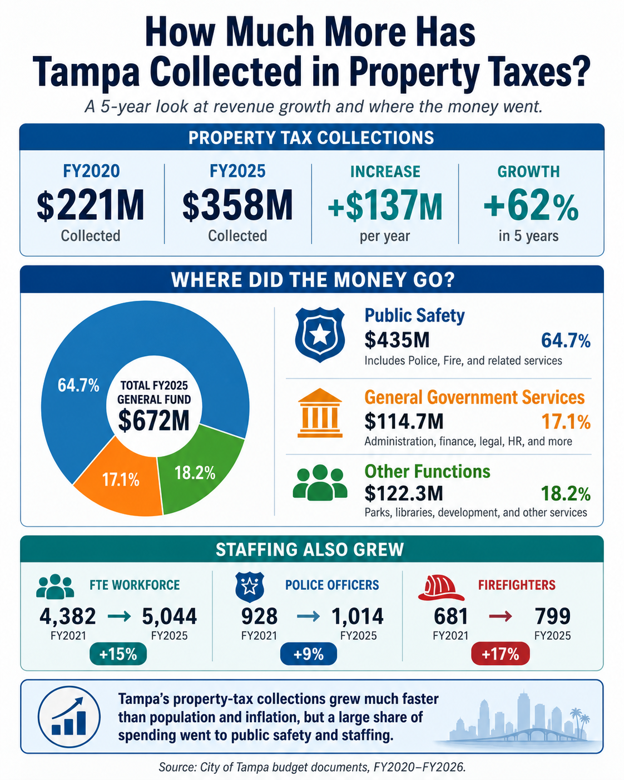
- City of Tampa property-tax revenue reached approximately $358 million in FY2025, up from approximately $221 million in FY2020.
- That's roughly $137 million more per year than Tampa was collecting five years earlier, an increase of about 62%.
- In FY2025 alone, Tampa property-tax collections increased another $20.4 million over FY2024. (City of Tampa)
- Tampa's FY2025 General Fund spent approximately $672 million, with about $435 million going to public safety. (City of Tampa)
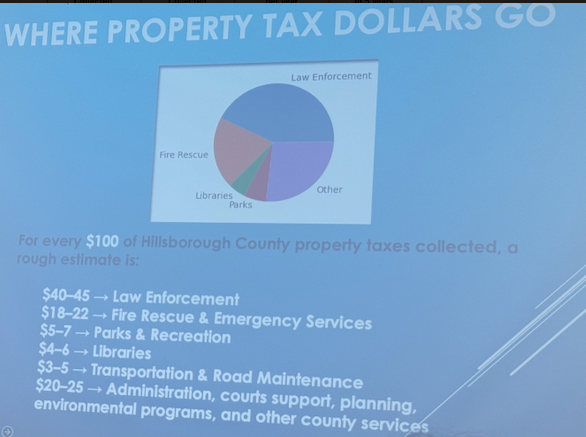
- Hillsborough County's Property Appraiser presentation estimates that for every $100 of county property taxes, roughly $40–$45 goes to law enforcement and $18–$22 to fire rescue and emergency services.
- Critics warn that reducing property taxes could lead to cuts to police, fire, EMS, infrastructure or replacement taxes and fees.
- Supporters argue that governments should reprioritize spending and other available revenues before cutting essential services.
- Hillsborough County itself is now building its FY2027 budget around possible property-tax reform while saying it intends to prioritize public safety, maintain current service levels and identify budget savings. (Hillsborough County Florida)
- Governor Ron DeSantis supports property-tax relief but has said the Legislature's final Amendment 3 is not identical to his original proposal.
- For Florida buyers: never assume the seller's current property-tax bill will become yours after closing.
What Exactly Is Florida Amendment 3?
Is Florida eliminating property taxes?
No.
That's one of the biggest misconceptions surrounding this debate.
Amendment 3 would substantially increase the homestead exemption applied to non-school property taxes.
If approved, the exemption would increase to $150,000 in 2027 and $250,000 in 2028. (Hillsborough County Tax Collector)
School property taxes would remain.
You would still receive a property-tax bill.
The Hillsborough County Tax Collector makes this particularly clear: even if Amendment 3 passes, school taxes and applicable non-ad valorem assessments remain. (Hillsborough County Tax Collector)
When would Amendment 3 take effect?
Florida voters decide on the amendment on November 3, 2026.
It requires at least 60% approval.
If approved, the first changes begin January 1, 2027, with the larger exemption phasing in over the following two tax years. (Hillsborough County Tax Collector)
What happens to rental properties and second homes?
The enhanced homestead exemption applies to qualifying primary residences, not investment properties or second homes.
But Amendment 3 also proposes lowering the annual assessment-growth cap on many non-homestead properties from 10% to 5%.
That's potentially meaningful for landlords, investors and second-home owners.
However, it does not mean a buyer automatically inherits the seller's low assessed value.
A sale can trigger reassessment.
Why Are Police, Firefighters and Sheriffs Worried?
Do property taxes really fund public safety?
Absolutely.
This is where I think critics deserve to be heard.
At a presentation from the Hillsborough County Property Appraiser, the office provided a rough estimate of how every $100 in Hillsborough County property taxes is used:
$40–$45 → Law Enforcement
$18–$22 → Fire Rescue & Emergency Services
$5–$7 → Parks & Recreation
$4–$6 → Libraries
$3–$5 → Transportation & Road Maintenance
$20–$25 → Administration, court support, planning, environmental programs and other county services
Put another way, approximately $58 to $67 out of every $100 in property-tax revenue is associated with law enforcement, fire rescue and emergency services.
That's significant.
And because public-safety budgets are heavily personnel-driven, they're not easy to reduce without eventually affecting:
- deputies and police officers
- firefighters
- EMS personnel
- response times
- equipment
- vehicles
- stations
- training
- pensions and employee benefits
So I understand why public-safety organizations are concerned.
My own niece wears the Hillsborough County uniform. I don't want fewer deputies on our streets any more than anyone else does.
But that's also why I wanted to dig deeper than simply accepting:
“Property-tax cuts equal police cuts.”
Are Property Taxes the County's Only Source of Money?
Does Hillsborough County have other revenue besides property taxes?
Yes. A lot of it.
Another slide presented by the Hillsborough County Property Appraiser showed property taxes as only one component of the county's overall revenue structure, with substantially more revenue coming from other sources.
That doesn't mean every dollar is interchangeable.
Some revenue is restricted.
Money from water and wastewater charges, impact fees, gas taxes, grants, bond proceeds and certain assessments may legally or contractually be dedicated to particular purposes.
So it would be inaccurate to say:
“The county has billions somewhere else. Just move all of it.”
But the opposite extreme is also too simplistic.
Not every dollar outside property taxes is locked away permanently.
Governments routinely prioritize spending, realign funds and transfer unrestricted resources where legally permitted.
So I think taxpayers should be asking a different question.
Could Hillsborough County Shift Other Revenue Toward Police and Fire?
Can local government reorganize its revenue before cutting public safety?
To some degree, yes.
The real question is how much flexibility exists.
If public safety truly is government's highest priority, then property-tax reform should force policymakers to examine the entire revenue and spending structure, not simply preserve the way every dollar has historically been allocated.
That could include:
- shifting unrestricted revenue toward core services
- reducing administrative spending
- consolidating programs
- delaying lower-priority capital projects
- slowing hiring outside core services
- allowing some departments to grow more slowly
- eliminating programs that no longer justify their costs
- reassessing subsidies and discretionary programs
- using reserves appropriately
- looking for efficiencies before reducing public-safety staffing
In fact, Hillsborough County says it is doing some of this now.
As it developed the proposed $14.1 billion FY2027 budget, county staff specifically said they were preparing for possible property-tax reform while prioritizing public safety, maintaining infrastructure and current service levels, identifying budget savings and investing in county employees. (Hillsborough County Florida)
That's important.
Because it demonstrates that the choice isn't necessarily:
Keep property taxes exactly as they are or lose deputies.
There are budgeting decisions between those two extremes.
What Happened to Tampa's Property-Tax Revenue Over the Last Five Years?
How much more property-tax revenue is Tampa collecting?
This is where the numbers caught my attention.
The City of Tampa collected approximately:
FY2020
$221 million
FY2025
$358 million
That's approximately:
+$137 million per year
compared with five years earlier.
Or roughly:
+62% in five years.
Tampa's FY2025 audited financial report confirms the City collected approximately $358 million in property taxes, which was itself another $20.4 million increase from FY2024's $337.6 million. (City of Tampa)
That does not mean Tampa accumulated $137 million in a bank account.
It means its annual property-tax revenue stream was approximately $137 million higher in FY2025 than it had been five years earlier.
That's an important distinction.
But it is still extraordinary revenue growth.
How Can Tampa Collect So Much More Without Raising the Tax Rate?
Can a city keep its millage rate flat and still collect more taxes?
Yes.
This is one of the most important parts of Florida's property-tax system.
A millage rate is simply the tax rate applied to taxable property value.
If taxable values rise substantially, government can collect significantly more revenue while keeping the headline millage rate unchanged.
For example:
A 6-mill tax on $1 billion generates approximately $6 million.
That same 6 mills on $1.2 billion generates approximately $7.2 million.
The government can accurately say:
“We did not raise the millage rate.”
The taxpayer can accurately say:
“You're still collecting substantially more money.”
Both statements can be true.
Tampa's FY2025 millage was 6.2076 mills. (City of Tampa)
What Is the Rolled-Back Rate?
What does Florida's rolled-back property-tax rate mean?
The rolled-back rate is essentially the millage rate calculated to produce approximately the same revenue from the existing taxable property base as the previous year.
New construction is excluded when calculating that comparison rate.
But new construction is still taxed once the adopted millage rate is applied.
That's important in a rapidly growing community.
A city can adopt something close to the rolled-back rate and still collect additional revenue from new:
- homes
- apartments
- offices
- stores
- commercial development
Growth creates expenses.
But growth also creates revenue.
Where Did Tampa's Additional Money Go?
Did Tampa simply waste the additional property-tax revenue?
The evidence doesn't support saying that.
And I think fairness requires acknowledging it.
Tampa's FY2025 General Fund spent approximately $672 million.
Public-safety expenditures accounted for roughly $435 million, or close to 65% of General Fund expenditures.
The City's audited financial report says public-safety spending increased approximately $58 million in FY2025 alone, driven largely by additional police and fire personnel and related employee-benefit costs. (City of Tampa)
So part of Tampa's revenue growth clearly went toward public safety.
That's real.
But government expanded elsewhere too.
The City added employees, programs and other recurring obligations during an extraordinary period of revenue growth.
And that's where I think another fair question emerges.
Did Tampa Turn a Revenue Boom Into Permanent Spending?
What is the risk of using rapidly growing tax revenue for recurring expenses?
This may be one of the most important questions in the entire Amendment 3 debate.
There is nothing inherently wrong with government collecting more revenue as a community grows.
And there is nothing inherently wrong with hiring more police officers or firefighters when a city needs them.
The problem comes if extraordinary revenue growth becomes treated as the permanent new baseline.
When additional revenue is spent on a one-time road project, that expense ends.
When additional revenue is placed into reserves, it creates financial flexibility.
When additional revenue is used to pay down debt, it can improve future finances.
But when additional revenue creates:
- permanent employees
- recurring salaries
- pensions
- benefits
- ongoing programs
- recurring contracts
the government needs that money again next year.
And the next year.
And the next.
That's how an unusually strong revenue cycle can eventually become a new minimum operating requirement.
Did Tampa and Hillsborough County Know Property-Tax Reform Was Coming?
Could local governments have predicted Amendment 3 in 2020?
No.
I don't think it would be fair to argue that Tampa or Hillsborough County should have known in 2020 that voters would face this exact constitutional amendment six years later.
They couldn't.
But governments don't only plan around risks they can predict precisely.
Property markets are cyclical.
Revenue growth changes.
Economic conditions change.
Legislatures change tax policy.
That's why governments maintain reserves and distinguish between recurring and non-recurring expenses.
When did major Florida property-tax reform become foreseeable?
By 2025, the possibility was much harder to ignore.
Property-tax reform had become a major statewide political issue, with lawmakers considering substantial changes and Governor DeSantis publicly pushing for major homeowner property-tax relief.
By the 2026 special session, there was no question that significant reform could reach voters.
And now Hillsborough County is explicitly building its FY2027 budget in preparation for possible property-tax reform. (Hillsborough County Florida)
That leads me to a question I think is completely fair:
Could some of this planning have started sooner?
Not in 2020 based specifically on Amendment 3.
But once property-tax reform became a serious possibility, local governments had an opportunity to examine:
- hiring
- program expansion
- recurring commitments
- reserves
- spending growth
- revenue diversification
before the potential revenue change actually arrived.
Was the Spending "Reckless"?
Did Tampa or Hillsborough County recklessly spend a property-tax windfall?
I wouldn't go that far based on the numbers alone.
“Reckless” requires proving that money was spent irresponsibly.
The data we have doesn't establish that.
But the numbers do justify asking whether government expanded too quickly during unusually strong revenue years.
That's a different argument, and I think it's a stronger one.
Tampa experienced extraordinary property-tax revenue growth.
Government staffing and recurring expenses grew during that period.
Now local governments are warning that a reduction in projected future revenue could threaten services.
That raises a legitimate fiscal-planning question:
Did government treat extraordinary revenue growth as a permanent baseline instead of preserving enough flexibility for the day that growth slowed or tax policy changed?
That deserves an answer.
Could Amendment 3 Lead to New Taxes or Fees?
Does Amendment 3 automatically create another tax?
No.
There is no automatic replacement sales tax or fee built into Amendment 3.
But critics are correct that governments facing lower property-tax revenue could eventually look elsewhere.
Potential responses could include:
- fees
- special assessments
- utility charges
- franchise fees
- sales-tax proposals where legally available
- other revenue mechanisms
Or governments could reduce spending.
That's why I think people should be careful when they hear:
“Property taxes will go down.”
It's fair to ask whether another cost eventually goes up.
But that is a possible government response, not something Amendment 3 automatically requires.
What Is Governor DeSantis Saying?
How does Governor DeSantis respond to warnings about public-safety cuts?
His basic argument is that government should reduce and reprioritize spending before threatening essential services.
Supporters of property-tax reform point out that Florida's extraordinary appreciation produced massive growth in local taxable values.
Their argument is that local governments benefited from that boom and shouldn't assume every dollar of that increased revenue must permanently remain part of government.
There is an important caveat:
The final Amendment 3 is not identical to DeSantis's original proposal.
So I would not describe this simply as “the DeSantis amendment.”
He drove the larger property-tax reform debate, but the Legislature ultimately produced the constitutional amendment voters will decide.
What Does This Mean for Florida Homeowners?
Who benefits most if Amendment 3 passes?
Qualifying homestead owners would potentially receive significant relief from non-school property taxes.
How much depends on:
- assessed value
- taxable value
- local millage rates
- taxing jurisdictions
- existing exemptions
Not every homeowner will save the same amount.
And school taxes remain.
What Does This Mean for Florida Homebuyers?
Will a buyer get the seller's current property-tax bill?
Do not assume that.
This remains one of the biggest mistakes Florida buyers make.
A longtime homeowner may have years of Save Our Homes protection keeping the assessed value substantially below market value.
After a sale, reassessment can cause the new owner's tax bill to look very different.
So whether Amendment 3 passes or not:
Never base your future housing budget solely on the seller's current property-tax bill.
Estimate the post-purchase taxes.
My Bottom Line
Here’s a more personal, natural version that still reads cleanly in the article:
I started digging into this because I really wanted to understand the public-safety argument. And quite honestly, I still don’t know how I’m going to vote. I was taught pretty early on to keep politics to myself, so I plan on making my mom proud and continuing to do exactly that.
What I do know is that I support law enforcement. My family has skin in the game. My niece is a Hillsborough County deputy, so when I hear concerns that property-tax reform could affect deputies, firefighters or emergency services, I pay attention.
And after looking at the numbers, I understand why public-safety professionals are concerned. Property taxes do fund a significant portion of those services.
But I also don’t think the conversation should stop there.
Tampa’s annual property-tax collections increased approximately 62% in five years. During that same period, government spending and staffing grew too. Property taxes are also not the only source of revenue available to local government. Some revenue is legally restricted, absolutely. But some revenue and spending can be reprioritized.
And Hillsborough County is already showing that planning around possible property-tax reform is possible. Its FY2027 budget is being developed with an emphasis on protecting public safety, maintaining current service levels and identifying savings.
So before voters are told that property-tax relief inevitably means fewer deputies, firefighters or first responders, I think taxpayers deserve to see more of the math.
I wanted to know what was actually fixed, what could be moved, what spending had grown, what had become permanent, and what options local government really has before touching core services.
Here’s what I’ve found so far.
What is legally restricted?
Quite a bit. Tampa’s ACFR says its special-revenue funds are specifically used for revenues that are legally restricted to particular purposes. Examples include local-option gas taxes for transportation projects, impact fees for capital improvements, HUD housing grants for housing programs, and certain non-ad valorem assessments for designated services. Water, wastewater and solid-waste operations also operate in separate funds rather than functioning like unrestricted General Fund cash
What can be moved?
Some money absolutely can be reallocated. Tampa regularly adopts budget resolutions transferring and reallocating funds. In 2025, for example, the City approved a $5 million reallocation within the General Fund for Tampa Fire Rescue personnel and operating costs. That proves at least some budget flexibility exists.
What spending can be reduced?
This is partly a policy choice, not something a budget document answers for us. But Hillsborough County has already identified at least one category of recurring discretionary spending it is willing to phase down: certain nonprofit funding is being reduced over several years, with recurring funding going to 50% in FY27, 25% in FY28 and zero in FY29 unless the organization meets specified exceptions.
What grew during the boom years?
We know Tampa’s General Fund spending rose materially. From FY2024 to FY2025 alone, expenditures increased from about $599.5 million to $672 million, a jump of $72.5 million. Public safety accounted for $58 million of that increase, culture and recreation rose $7.1 million, general governmental services rose $5.5 million, and environmental services rose $1.9 million
What became permanent?
The clearest permanent or recurring growth is personnel. Tampa’s FY2025 report says the large public-safety increase was driven by additional police and fire personnel and related employee-benefit costs. Salaries, benefits and pensions are recurring obligations, not one-time purchases.
What services are truly core?
There is no single universally binding definition across every city and county budget. But Hillsborough County itself says its FY2027 guiding principles are to prioritize public safety, maintain county infrastructure, equipment and current service levels, while also finding savings. That gives us a pretty good indication of what the County currently treats as core priorities.
That is the question I keep coming back to. Property taxes clearly help fund police, fire and emergency services. But they are not the only source of local revenue, and not every dollar in a city or county budget is equally fixed. Before taxpayers are told that meaningful property-tax relief necessarily means fewer deputies, firefighters or first responders, I think local governments should clearly show what revenue is legally restricted, what can be reprioritized, what spending grew during the boom years, what became recurring, and what alternatives were considered first.
Has local government exhausted every reasonable alternative before asking taxpayers to choose between property-tax relief and public safety?
Florida Amendment 3 FAQ
Is Florida eliminating property taxes in 2026?
No. Amendment 3 does not eliminate all Florida property taxes. It would substantially increase the homestead exemption that applies to non-school property taxes.
When is the Florida Amendment 3 vote?
Election Day is November 3, 2026. Amendment 3 needs at least 60% approval to pass. (Hillsborough County Tax Collector)
What would the Florida homestead exemption be if Amendment 3 passes?
The proposal increases the applicable exemption to $150,000 in 2027 and $250,000 in 2028 for qualifying non-school property taxes. (Hillsborough County Tax Collector)
Will school property taxes go away?
No. School taxes remain.
How much more property-tax revenue is Tampa collecting than five years ago?
Tampa collected approximately $358 million in FY2025 compared with about $221 million in FY2020, an increase in the annual revenue stream of approximately $137 million, or 62%.
Did Tampa raise its millage rate by 62%?
No. That's an important distinction. Much of the revenue growth resulted from increasing taxable property values and expansion of the tax base rather than an equivalent increase in the millage rate.
Where do Hillsborough County property-tax dollars go?
According to estimates presented by the Hillsborough County Property Appraiser, roughly $40–$45 of every $100 goes to law enforcement and $18–$22 goes to fire rescue and emergency services. The remainder supports parks, libraries, transportation, administration, courts, planning and other county services.
Are property taxes Hillsborough County's only source of revenue?
No. Property taxes are one of many county revenue sources. However, some other revenue streams are legally or contractually restricted to particular purposes.
Can Hillsborough County use other revenue for police and fire?
Some unrestricted revenue can potentially be reprioritized, but not every revenue source can legally be moved. The important budgeting question is how much flexibility exists before core services need to be reduced.
Does Amendment 3 automatically cut police or fire budgets?
No. The amendment reduces the taxable base available to local governments. Individual cities and counties would decide how to respond through their budgets.
Could Amendment 3 cause other taxes or fees to increase?
Possibly, but it does not automatically create another tax. Local governments could choose spending reductions, other revenue sources, fees, assessments or some combination of responses.
Did Tampa and Hillsborough County know this specific amendment was coming in 2020?
No. It would be unfair to say they could have predicted this exact 2026 amendment. But by 2025, significant Florida property-tax reform had become a serious political possibility.
Could local governments have prepared sooner?
Potentially. Governments routinely plan for revenue volatility, and by 2025 major property-tax reform was increasingly foreseeable. Hillsborough County is now explicitly planning its FY2027 budget around possible reform while prioritizing public safety and identifying savings. (Hillsborough County Florida)
Does Amendment 3 help rental-property owners?
Rental properties don't receive the enhanced homestead exemption, but the amendment proposes reducing the annual assessment-growth cap on many non-homestead properties from 10% to 5%.
Will a Florida homebuyer inherit the seller's current property taxes?
Not necessarily. A sale can trigger reassessment. Buyers should estimate their expected post-purchase property taxes rather than relying solely on the seller's current tax bill.
Sources
City of Tampa Annual Comprehensive Financial Reports, FY2020–FY2025. The City's FY2025 audited report confirms $358 million in property-tax revenue, $672 million in General Fund expenditures and the substantial increase in public-safety spending. (City of Tampa)
Hillsborough County FY2027 budget materials and Board of County Commissioners meeting recap regarding preparation for possible property-tax reform, public-safety priorities and budget savings. (Hillsborough County Florida)
Hillsborough County Tax Collector Amendment 3 voter guide, including the current ballot status, implementation schedule, homestead changes and school-tax treatment. (Hillsborough County Tax Collector)
City of Tampa FY2025 adopted millage resolution. (City of Tampa)
Hillsborough County Property Appraiser presentation materials provided at the local property-tax presentation referenced in this article.
This article is for general educational purposes and is not legal, accounting or tax advice.
Categories
Recent Posts








GET MORE INFORMATION

Broker-Owner